Wednesday, 22 October 2008

INVITATION TO...

THE CAMPSIE BRANCH SSP have invited Cuba Solidarity to Kirkintilloch to facilitate a session on the Miami 5, and to talk about Cuba.


About Scottish Cuba Solidarity


Despite the 40 year old illegal blockade and ongoing aggression the lives of all Cubans have been transformed since the revolution. Outstanding achievements in education, healthcare and other social improvements have been made. Education is free to the highest level. Medical care is also free.


SCSC call for the immediate release of the Miami Five, five Cuban patriots imprisoned in the US since 2001. Imprisoned on trumped up conspiracy charges the five were trying to prevent acts of terrorism being carried out against Cuba. We support the international campaign to free the five.

www.cuba-solidarity.org/

Saturday, 18 October 2008

Identity Politics and welfare not warfare - views from two Campsie members...

Persepolis –A discussion on Identity Politics.


Campsie branch recently showed the film "Persepolis" in Kirkintilloch Leisure Centre (we meet there on the Second Saturday morning of the month at 10.30am.)

Pamela Page reviews:


Persepolis is an angry, yet simultaneously joyous and inspirational, animated film based on Majane Sartapi’s autobiographical graphic novel of the same name.

I highly recommend the film! It is funny, quirky and great entertainment on many levels - but rather than give a review I am going to discuss it in terms of how I think it can help Socialists understand the importance of Identity politics.

The story follows a young girl as she comes of age against the backdrop of the Iranian Revolution.

Socialists can certainly identify with a lot of Marji’s rebelliousness - especially at the start when we see the mass protests against the Shah. Even after the Islamic fundamentalist’s take over and her Communist uncle is jailed - her spirit is not crushed. Marji refuses to stay out of trouble whether it’s secretly buying Western heavy metal music, wearing unorthodox clothing or openly rebutting a teacher’s lies about the abuses of the government.

As the film goes on we start to see how women are doubly oppressed by the regime.
There are many obvious examples in the film. One recurring theme however, whether in Islamic fundamentalist Iran or in West, is the very real threat of sexual violence, rape as a weapon of war and sexual slurs as common parlance.

In one scene Marji’s mum has a mild altercation with a guard of the revolution in a supermarket car park. He shouts at her contemptuously “Women like you I bang like whores and throw in the trash!”

In another scene she warns her young daughter not to speak out against the regime in class. It is illegal to kill a virgin she tells her daughter so they will ‘have to’ rape her first!

Fearing her arrest for her outspokenness Marji’s parents send her to a school in Vienna, Austria.

Sexual slurs are echoed over and over again when she is in the West. ‘Slut’, ‘Whore’ and ‘prostitute’ are commonly, and casually, used.

Marji feels intolerably isolated in a foreign land surrounded by people who take their freedom and peace for granted while making her feel ashamed of being Iranian.

Marji becomes enraged when her ‘politically aware’ friends dismiss politics as meaningless because it is not an abstract academic enterprise for her. In her experience these issues are life and death. Her country is at war!

Highlighting how some people face multiple oppressions - whilst others are entirely unaware of their own privilege.

As socialists we need to be careful not to dismiss people’s experiences in this way and seek to understand the converging oppressions that people face. Unless we believe that class alone shapes someone’s identity.

I am particularly interested in a feminist analysis of the film because as a woman – I can’t but know that Patriarchy exists – it is part of my day to day experience. Therefore Marji’s anger struck a chord with me when her experience is dismissed by those in a privileged position.

In this regard I believe that socialists have to be vigilant against lazily accepting sexist rhetoric against women politicians - Sarah Palin being the most recent example - just because we disagree with their politics.

In my view Socialists have to strive to understand identity politics if we are to be taken seriously in wider society about ending oppression. Rather than mimicking those oppressive attitudes ourselves.

We need to recognise that if we were to have a socialist revolution tomorrow – without an analysis of identity politics – we would still have sexism, racism, homophobia, islamophobia, western elitism and many other prejudices.

That is not the world that I am fighting for.

Marji’s granny advises her as she goes into exile ‘Be true to yourself and never forget who you are!’ Wise words.


Welfare, Not Warfare


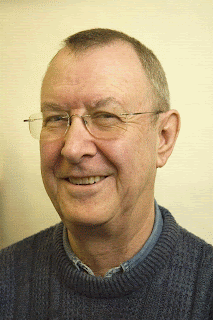
Ron Mackay has been a socialist all of his life. A retired teacher, he has been arrested for his principles of non-violence and anti-nuclear weapons. He can be found playing sax at most anti-war and pro-socialist demonstrations.


Photo originally appeared here: www.roystpierre.com


The old socialists used to say " you can't have guns and butter". You can't have warfare and welfare. The 3 main parties at Westminster are infact a variation of one - the party of warfare. Every aspect of welfare, health, education,the social services and the arts face cuts while expenditure on wars and preparation for wars is soaring. Trident at present costs millions and renewed trident will cost even more. Developments at Aldermaston and elsewhere, where our nuclear,chemical and biological research is carried out, adds to the emormous drain on our resources.
In the Glenrothes election the (3 in 1) war party will struggle against the S.N.P. The media,essentially exclusively capitalist, will hype up the sham battle between the different strands of the war party. The S.N.P. , tho' more progressive than the main war party, only serves to distract from the socialist policies which give the only real answer to the present crisis.


Lincoln got it wrong - you can fool an awful lot of people for a very long time but we must struggle against the forces dedicated to warfare. The alternative is to sleepwalk towards W.W.3. Socialism is trhe only hope for humanity. Our goal is not easy but essential.

Tuesday, 7 October 2008

Jim Bollan on Cordale Housing Association

Jim Bollan, leading a discussion on "How we take the councils" and sharing his experience in West Dunbartonshire Council as well as explaining the amazing community owned Cordale Housing Association. The video is just over 20 minutes long.


Friday, 3 October 2008

This Greed Was Beyond Irresponsible


by Campsie Branch member, Bill Newman

Bill Newman spent most of his working life in banking, latterly as head of economics and then as Assistant General Manager of a City of London bank. For some 15 years he was also editor of and wrote for a journal on international monetary economics.

He has an interest in African matters, having been
responsible for economic and political reporting on sub-Saharan Africa for Westminster Bank and writing for some years for the Europa Yearbook on Somalia and Ethiopia.

He
was also on the Executive Committee and the Management Committee of the Banking, Insurance and Finance Union (BIFU) and a delegate to the TUC.


No. The headline above was not from the Morning Star, but was from that house newspaper for the rich and powerful, the Financial Times of 18 September. And how about these headlines from the Herald: Capitalism has proven Karl Marx right again and Bailing out banks is socialism for the rich. All this is true and reflects the intrinsic truth about capitalism, but you won't hear any MPs or MSPs accepting this or recognising that this profound crisis merely reflects the inevitable effect of uncontrolled capitalism, nor will they acknowledge that socialism is the answer to these periodic catastrophes. The press and politicians fulminate about the greed of financial traders and bankers and fail to recognise that it is this greed which is the rationale for capitalism. Without greed and exploitation, the whole structure of capitalism would collapse.

It may seem strange that apparently intelligent men could bring mighty financial edifices to their knees, but if you are earning stratospheric sums trading bits of paper to other overpaid traders, why worry that these pieces of paper might represent worthless or, at the very least, suspect commodities. Did no-one not bother to consider that sub-prime mortgages, for example, were, by their very nature highly risky loans and that by the time they had been packaged up with other dubious products, it was virtually impossible, once they had been traded time and time again on the financial merry-go-round, to tell what underlying value they represented. Some years ago when I worked in banking, I queried with the Bank's chief trader what the quantifiable risks in the derivatives he traded were. In reply he pointed out that the Bank made substantial profits from such trade and that all banks of any consequence were also engaged in this paper chase. In consequence, I raised my fears with the Bank's Board only to receive the same answer. In essence, the boom in these dubious trades was a classic case of pyramid selling, not unlike the South Sea Bubble, and only the greed of bankers blinded them to the escalating risks of these increasingly complex markets.

But do the travails of overpaid bankers affect the average citizen? Unfortunately they do and the coming months will show a massive decline in all economic activity as banks try to rebuild their balance sheets, refuse to extend credit and shed staff. It is impossible to believe, for example, the reassuring noises that Santander makes on employment in their subsidiaries in Britain. If Abbey, Alliance and Leicester and Bradford and Bingley are owned by the same company, is it credible to believe that these banks and their staff will not suffer from consolidation? Without access to credit, what is left of our manufacturing industry will shrink at an escalating rate, unemployment will soar and house price collapse will leave many with unsustainable negative equity.

So what is the response of our politicians? Inevitably, the bail-outs envisaged are bail-outs for the very people who got us into this fine mess, a fact that the American public has been quick to realise. Nor will the enormous sums involved remedy the sickness in the world economy. It is not surprising that our leading politicians seem to have no knowledge of Karl Marx who , as Ian Bell in the Herald pointed out, defined with precision the inevitable economic crises at the heart of capitalism. It is rather more surprising that they seem to have forgotten, if they ever knew, the lessons taught by Lord Keynes, so besotted have they become by the simplistic notions of the free market as propagated by American economists of the so-called Chicago School. It should surprise no-one, not even politicians, that the only UK bank to be trusted by the public at the moment is the only nationalised bank, Northern Rock; so successful that the Bank's deposit services have been curtailed! The lesson, which our politicians will not learn, is that publicly owned banks are secure and privately-owned banks are not. At the very least, it would help if the Government greatly expanded public expenditure, but the very reverse seems to be happening.

The answer to the pending economic crash, is socialism, and now should be an ideal opportunity to get this message across. Given the control of the media and the absence of sympathetic politicians, this will not be easy, but the public will be looking for real solutions and will not be fooled for ever by sticking plaster measures of Western governments. The Scottish Socialist Party offers a principled and practical solution to our economic ills and it is crucial that we get our message across.

Monday, 29 September 2008

Sustainability - some thoughts

Ann Kaniuk with Campsie branch member, Ron Mackay.


Ann Kaniuk, Campsie Branch member, shares her thoughts on sustainability.

As if the credit crunch and collapse of banking wasn’t enough, climate change is hitting us before we’re ready, and the oil is running out; it really is finite, and we’re using it up as fast as we can. North Sea oil has peaked, along with all other sources.

It’s a mug’s game to be dependent on other countries for our energy (new French nuclear power stations built in Britain, imported Russian gas, German electricity…). We need to create our own energy. Wave power good, wind power problematic. Huge wind farms are erratic and destructive, and they’re usually owned by profit-hungry foreign powers anyway. Putting small windmills in communities makes more sense – not attached to houses, where they can shake the walls to bits, but standing free in strategic places. What CAN be attached to houses – and SHOULD be attached to every south-facing roof in Scotland – are solar panels. Photovoltaic cells would be ideal – creating electricity that could be used by each household, with the surplus fed into the national grid. The technology for these is still a way off, but people should be working on it. Economy of scale should bring the price down. What we could do right now, though, is put solar heating
panels on all our roofs, providing hot water. We need the hot water for heating, and washing dishes and clothes. By hand (remember that?). No more dishwashers, washing machines, and tumble driers. Too profligate, when we have the sun shining for free.


Ann with SSP Campsie member Thomas Swann campaigning recently in Glasgow East.


Flying and trucking food from all over the globe is becoming increasingly expensive. Oranges, pineapples and bananas may become unaffordable luxuries again. We need to grow our own food. That means not using our land for biofuels, but using all our land for food. Look your last on vast lawns with stripes made by power-mowers. Dig them up. Grow food.

We need to stick together to overcome the challenges ahead. Sticking together sounds good to me.

Friday, 26 September 2008

Branch meeting - in Holland...

Thomas Swann on his recent move of branches from Campsie... to Nijmegen in Holland.


As the film began, I was reminded of the cold and wet Saturday mornings spent in Kirkintilloch leisure centre with other members of Campsie Branch probably watching a John Pilger documentary or something else as part of our educational activities. The five minutes into the film it stopped and someone had to monkey around with the laptop before it would start up. Again, I was reminded of the regular Campsie Branch film mornings. This was my first real experience of the Dutch Socialist Party.


The film was 'Turtles Can Fly', the first film to come out of Iraq since the US/UK invasion. I'd been meaning to get in touch with the local branch of the Socialist Party before I moved to the Netherlands and was encouraged by the warm welcome I received from the local organiser and the other members who were present at the screening. The Socialist Party began as a small left-wing grouping but through a process of community engagement and activism has grown from having one member of parliament in the early 90s to twenty-five today, plus a large number of elected local government officials. It's been held up as the success story of the Left in Europe, and it is largely thanks to its work in communities, on the ground, as it were, that this level of support has been achieved.


Focusing on a few areas, including Nijmegen, where I am now living (you might recognise the name from 'A Bridge to Far'), the party organised projects as ambitious as offering free medical care to members of the community, and now claims a number of 'strongholds' where it has a base of local support. In a number of areas, again including Nijmegen, the Socialist Party participates in the local government along with other Left parties such as the Green-Left.


In this blog, which will appear most likely irregularly on the campsiesocialists.com website, I will attempt to relate my experience of Left-wing politics and activism in the Netherlands, and specifically in Nijmegen, to similar situations in Scotland, as well as comparing the general social, political and economic contexts in which these are taking place. But my research and reporting will not be confined to the Socialist Party, though as an organised political party which stands in national and local elections this will obviously have a large relevance to a member of the SSP as I am. Nijmegen is also one of the centres of Anarchist activism in the Netherlands and has a number of collectively owned bars and cafés which have developed from squated buildings to legitimate enterprises supported through low rent conditions by the Left-wing council of the town.


So, hopefully my next entry in this blog will have something more concrete than a simple introduction and will perhaps provide information which will prove useful to Socialist and Anarchist activists in Scotland, and particularly in the Campsie/East Dunbartonshire area.

Friday, 19 September 2008

Global Economic Crisis


Many of the articles in this section were written by Raphie De Santos. In these articles, Raphie predicts the fall of HBOS - and warns about other banks.


Raphie was head of Equity Derivatives Research and Strategy at Goldman Sachs International. He was an advisor on derivatives and financial markets to the Bank of England, London Stock Exchange, London International Financial Futures and Options Exchange and the Italian Ministry of Finance.

Raphie has been a guest lecturer on derivatives and financial markets at Harvard and New York universities and the London School of Economics and has spoken at the annual Nobel Foundation conference in Stockholm.


Click on image below to go to the SSP analysis of the current crisis.

Thursday, 18 September 2008

Stop Power Company Profiteering

Since 2000 gas bills have doubled & electricity bills are up 75%.
The energy companies claim these increases are unavoidable as the cost of oil and gas rises on the world market.

But wait.

These same energy companies have seen their profits increase 600%. Eon, Centrica, NPower and the others made £3,000m this year compared to £557m in 2003.
WHO PAYS FOR POWER CO. PROFITEERING?

We do.

The average combined gas and electricity bill in Britain is now £1,500 per household per annum and rising. The consumer group ‘Energywatch’ estimates there are now 5.5million households suffering from ‘fuel poverty’. [* When 10% of all household income goes on energy = fuel poverty].

There are now 6.8m people deep in debt to energy suppliers and they are in no position to cope with further price increases.
Pensioners will not be able to keep warm this winter and will die in their tens of thousands. This simply cannot be tolerated.

SO WHAT IS TO BE DONE?

The Scottish Socialist Party believes there should be a windfall tax on fuel company profits and bills should be held down.
But we also believe the energy companies should be taken back into public ownership. The rise in gas and electricity prices has been nowhere near as bad in the rest of Europe, the industry here has clearly been mis-managed.
The government must ensure everyone has the energy supplies they need as winter approaches. This is a right.
And if the government does not intervene, then people are entitled to say to say to energy company profiteering

‘WE WON’T PAY’.

SSP - THE LEFT ALTERNATIVE TO NEW LABOUR AND THE SNP


Click on form below and then print: