
Showing posts with label PCS. Show all posts
Showing posts with label PCS. Show all posts
Thursday, 30 June 2011
DVLA PCS Glasgow Branch Secretary Willie Telfer interview for Daily Record
With thanks to http://www.dailyrecord.co.uk/


Friday, 27 May 2011
STAND UP FOR SCOTLAND AGAINST CUTS
By Richie Venton, SSP national workplace organizer

25 May 2011
The annual conference of the UK’s fifth-biggest trade union, the Public & Commercial Services union (PCS), marked a decisive turning point in the resistance movement to public sector cuts.
The delegates there, representing 300,000 members, with branch mandates behind them, voted almost unanimously to ballot for strike action and action short of strikes, on the issues of jobs, pay and pensions.
They explicitly named 30th June for a one-day strike, and are seeking simultaneous strike action by other public sector trade unionists. Teaching unions – UCU, NUT and ATL – seem firmly committed to this day of united action. Other unions – UNITE and UNISON- have signed agreements with the PCS to combine and collaborate in anti-cuts action. Their leaderships should now move without delay to ballot members in affected areas for strike action to coincide with the plans for 30 June.
Build 30th June strike
And every other union in the public sector should be pressed from its branches, union reps and membership to follow suit. Even a partial general strike of public sector workers – numbering over 600,000 in Scotland alone – would be an industrial and political hurricane that could begin to blow the axe-wielding governments off course, at Westminster, Holyrood and local council levels.
There is no shortage of reasons for united action. Most people have yet to feel the full force of the storm of cuts descending on our workplaces and communities – apart from some of society’s most vulnerable, the sick and disabled, and big swathes of council workers.
Cameron and Clegg’s cuts orgy of £81billion includes £9bn being chopped off benefits for the sick and disabled. Over 5,000 of those hammered by these cruel cuts braved all obstacles to demonstrate in London last week. Protests in Scotland are being mounted against the vulture capitalists of Atos, the company hired to hand out callous, unprofessional, cost-cutting medical judgments that throw people off slightly higher rates of benefit.
Hurricane hits Scotland
But the looming assault on jobs – with economists predicting up to 100,000 job losses in Scotland – local services, pay and pensions are a cocktail about to explode and cause terrible social and human wreckage. The generalised nature of the attacks require a generalised response – a potent combination of direct action protests, united strike action, and hard-hitting arguments that explode the lie that cuts are either necessary or unavoidable.
Everyone would welcome the pre-election pledge of ‘no compulsory redundancies’ in the public sector from the Scottish government. But nobody should have to pay the price demanded for this promise – years of pay cuts and effectively a no-strike deal.
And one of the unions whose leadership was most craven in bowing down to a pay-cutting, conditions-hacking deal with COSLA – the EIS – has been given a rude lesson in the simple fact that weakness invites aggression. COSLA now wants to increase teaching hours; lengthen the working week; wipe out time protected for vital lesson preparation and marking; slash holidays and make them training days instead; and bring in fixed-term contracts for promoted teachers. All this on top of a two-year pay freeze 9at least a 10 per cent cut in reality).
Nobody is safe
Whether it is teachers facing this warfare from their employers, lecturers and students facing wholesale course closures and job losses, disabled people confronted by closure of their centres, or civil servants hit by closure of local offices in areas officially declared to be the unemployment blackspots of Scotland, nobody is safe. And that’s even before the £3.3bn cuts demanded of the Scottish government over the next two years.
The outcome of the Scottish elections was an attempt by besieged communities to find shelter from the storm of cuts issuing from Downing St. Mostly they entrusted the SNP to stand up for Scotland. The SNP made a good job of luring people into thinking they would do precisely that, and hid from view their spineless failure to stand up in defiance of the Westminster butchers’ £1.3bn cut to the Scottish budget last October.
And they cunningly disguised their plans to carry through cuts, not by defying and refusing to implement them, but by delaying them beyond the recent elections, stockpiling them, creating the conditions for a ‘double whammy’ of cuts over the next 2-3 years.
Demand SNP resist cuts
Now the SNP are in power, with hopes and expectations of protection raised. So anti-cuts campaigners – and in particular the STUC and various mass-membership trade unions – should demand the new government fulfils the hopes invested in them, use their popular mandate, declare unequivocally that they will refuse to pass on Westminster’s butchery, and mount a mass campaign of the Scottish people demanding the powers and the money to defend every single job, service, community facility, pay packet and pension.
Alex Salmond quite rightly immediately demanded of the London government an extension of powers for the Scottish government – including control over excise duties and Corporation Tax. But instead of demanding the latter to slash tax on big business to Southern Irish levels of 12 per cent – as Salmond clearly wishes to do – the unions should demand this extension of powers for Holyrood, not to reduce but to increase Corporation Tax to its pre-Thatcher level of 52 per cent – a policy that the PCS union shares with the Scottish Socialist Party.
Tax big business and the rich
That would enormously expand the funds available to the Scottish government, in order to build the best public services and welfare system in Europe, with a vast expansion of jobs, mopping up the criminal waste of a young generation left jobless, turning talent to the use of society as a whole.
One of the best possible ways of holding the newly elected Scottish government to account, of demanding they give material reasons for the “hope” and “vision” which they astutely preached to win the election, is to build a mass strike and rallies on 30 June. Public sector workers, students, communities, disabled people, pensioners … an army of resistance to the cuts on that day showing their angry determination, would not only rattle the severely weakened and divided ConDem Coalition, but also put the SNP government on the spot – not to mention an array of council leaderships who are busy slaughtering jobs, conditions and services.
Victories through action
In campaigning for 30 June to become a mass show of unity in action, we should be encouraged by several recent victories against cuts. Cameron, Osborne and others have been spewing out bellicose, bloodcurdling class warfare against workers and their unions, with for instance Osborne advising the Institute of Directors to “get stuck in” with even worse attacks on workplace health and safety regulations and more vicious anti-union laws than even Thatcher dared to wield. But alongside that, the ConDem government is executing more U-turns than the average professional ice-skater.
A mass petition frightened them into dropping plans to privatize the woodlands – but now they want to slash one in four Forestry Commission workers’ jobs.
As the interview with Willie Telfer of PCS [see below/box] reveals, their plans to crucify the coastguard service have been thrown into rapid meltdown by a powerful community and trade union campaign. And bosses in the Driving Services Agency have capitulated in the face of threatened strike action by PCS members against a brutal array of cuts they’d planned. Action works!
BA battles
Twin lessons on this theme arise from the 2-year-long battle conducted by BA cabin crews, members of the UNITE union.
These workers originally had no option but to strike against multiple attacks on their jobs, pay and conditions – including reduction of staffing levels for in-flight crews, and the introduction of new cabin crews on far worse wages and conditions, all imposed without even seeking talks with the union.
The UNITE members were driven to strike to defend union recognition, in order to defend their conditions against blatant attempts to wipe out both.
The tenacity of the cabin crew UNITE members has been remarkable, but a combination of anti-union laws and failure by the national union leadership to rapidly spread the action to the wider BA workforce left them in a dangerous stalemate, ruthlessly exploited by management, who launched a vicious press propaganda war, and meantime victimised strikers.
They disciplined and sacked UNITE union reps, ripped up union facilities previously agreed, and withdrew travel concessions from staff who had taken part in perfectly legal strikes. The battle went from defence of staffing levels and pay to one for the very survival of the union as a workers’ defence organization.
Now, faced with further strike ballots, BA bosses have conceded on most of their witch-hunt against the union, its reps and its members, restoring travel concessions to the strikers; restoring wages docked from crew off sick during the strikes; conceding union facilities again; and agreeing binding arbitration through ACAS on all the union reps who were victimized. A victory for the tenacious action of union members on those issues – but no concession whatsoever has been won on staffing levels and the galloping introduction of lower-paid new starts.
The twin lessons for other workers from this protracted struggle is that action forces concessions out of even the most hard-faced exploiters, but action in isolation from wider workforces severely weakens the chances of outright victory.
All out 30th June
Over 250,000 civil servants striking on 30 June, alongside tens of thousands of teachers and lecturers, would be a powerful body-blow to those in government hell-bent on making ordinary people pay for the bankers’ and billionaires’ wrecking ball to the economy.
But what an infinitely more potent weapon it would be if they were joined by EIS members facing the worst assault on their conditions in generations from COSLA; plus Scottish NHS staff who face 3.3 per cent cuts to health care this year and a future with redundancies, as Heath Boards seek to cut their deficits, according to new research by the British Medical Journal; and council workers who are already facing the brunt of pay cuts, work overloads and savage job losses?
Action and arguments
Every opponent of cuts, all who yearn a decent, civilized society that raises hopes fro the future and protects the most vulnerable, should work flat out to make 30 June the biggest and widest possible day of strikes and rallies.
Direct action protests against the perpetrators of cuts, combined with arguments for taxing the rich and taking wealth into public, democratic ownership, will help to raise the sights of people who otherwise despair at what the future holds.
The SSP will not flinch in helping build such actions and popularizing socialist alternatives to the cuts. We will stand up for Scotland – and demand the newly elected SNP government do the same, rather than asking for the power to cut taxes to the obscenely rich whilst sharpening the knives for the jobs, wages and public services that ordinary Scots depend upon.
Richie Venton spoke to Willie Telfer, PCS Dept for Transport Group Assistant Secretary
“There are 18 Coastguard stations in the UK. The government planned to centralize them into two super-stations.
There was huge uproar, for instance in Stornaway and Shetland, with mass community campaigns.
Coastguards tend to be ex-fishermen or seafarers, and live locally. There are also retained coastguards, with jobs ranging from the local church minister to civil servants. The service is a matter of life and death, and local communities know that. They know how absurd the government plan is, to leave only two stations, near Aberdeen and Southampton, over 600 miles apart!
So the fury was deep-rooted, with, for example, 250 at public meetings in Stornaway.
It was a mostly community-led campaign, with the scattered PCS membership (coastguards) joining in – with the open threat of strike ballots by PCS across the entire department for transport if there are any compulsory redundancies; driving examiners standing up for coastguards.
Faced with this uproar, the government has made it clear they are not going to stick to their original, crazy plan of only two stations, though it’s still unclear how many will be saved. This goes to show what pressure can achieve.
In another section of the Dept for Transport – the DSA – we have won an outright victory, this time led by trade union action.
The Cardiff DSA office does the admin for driving tests in England and Wales, and includes the Welsh language unit. DSA management wanted to close it down, to get their hands on the building, and made it plain there was no way they would back down.
PCS balloted and won a massive vote for strike action. The Cardiff PCS DSA branch led the big anti-cuts march to the Welsh Assembly; were prominent on the TUC’s 26 March demo, and won the backing of politicians from several parties.
This high profile campaign, and the mere threat of strike action, has forced the intransigent DSA management into a total capitulation, saving our DSA in Cardiff, but also winning five other union demands, including a moratorium on plans to shed 40 per cent of the Driving Test centres.
Fighting the cuts, you often run into those who say ‘it can’t be done’. These two examples prove the government and employers can be stopped – even before generalised, widespread action.
This government is a coalition, divided and weak. So June 30th is not just a show of strength, but another step on the road to halting the cuts. And within PCS, we are not just building for national action, but also encouraging action locally and within groups/departments. Whilst defending ourselves from the government sledgehammer we are not going to allow ourselves to be tickled to death!”
(Watch Willie Telfer speak at an anti-cuts rally in a personal capacity)

25 May 2011
The annual conference of the UK’s fifth-biggest trade union, the Public & Commercial Services union (PCS), marked a decisive turning point in the resistance movement to public sector cuts.
The delegates there, representing 300,000 members, with branch mandates behind them, voted almost unanimously to ballot for strike action and action short of strikes, on the issues of jobs, pay and pensions.
They explicitly named 30th June for a one-day strike, and are seeking simultaneous strike action by other public sector trade unionists. Teaching unions – UCU, NUT and ATL – seem firmly committed to this day of united action. Other unions – UNITE and UNISON- have signed agreements with the PCS to combine and collaborate in anti-cuts action. Their leaderships should now move without delay to ballot members in affected areas for strike action to coincide with the plans for 30 June.
Build 30th June strike
And every other union in the public sector should be pressed from its branches, union reps and membership to follow suit. Even a partial general strike of public sector workers – numbering over 600,000 in Scotland alone – would be an industrial and political hurricane that could begin to blow the axe-wielding governments off course, at Westminster, Holyrood and local council levels.
There is no shortage of reasons for united action. Most people have yet to feel the full force of the storm of cuts descending on our workplaces and communities – apart from some of society’s most vulnerable, the sick and disabled, and big swathes of council workers.
Cameron and Clegg’s cuts orgy of £81billion includes £9bn being chopped off benefits for the sick and disabled. Over 5,000 of those hammered by these cruel cuts braved all obstacles to demonstrate in London last week. Protests in Scotland are being mounted against the vulture capitalists of Atos, the company hired to hand out callous, unprofessional, cost-cutting medical judgments that throw people off slightly higher rates of benefit.
Hurricane hits Scotland
But the looming assault on jobs – with economists predicting up to 100,000 job losses in Scotland – local services, pay and pensions are a cocktail about to explode and cause terrible social and human wreckage. The generalised nature of the attacks require a generalised response – a potent combination of direct action protests, united strike action, and hard-hitting arguments that explode the lie that cuts are either necessary or unavoidable.
Everyone would welcome the pre-election pledge of ‘no compulsory redundancies’ in the public sector from the Scottish government. But nobody should have to pay the price demanded for this promise – years of pay cuts and effectively a no-strike deal.
And one of the unions whose leadership was most craven in bowing down to a pay-cutting, conditions-hacking deal with COSLA – the EIS – has been given a rude lesson in the simple fact that weakness invites aggression. COSLA now wants to increase teaching hours; lengthen the working week; wipe out time protected for vital lesson preparation and marking; slash holidays and make them training days instead; and bring in fixed-term contracts for promoted teachers. All this on top of a two-year pay freeze 9at least a 10 per cent cut in reality).
Nobody is safe
Whether it is teachers facing this warfare from their employers, lecturers and students facing wholesale course closures and job losses, disabled people confronted by closure of their centres, or civil servants hit by closure of local offices in areas officially declared to be the unemployment blackspots of Scotland, nobody is safe. And that’s even before the £3.3bn cuts demanded of the Scottish government over the next two years.
The outcome of the Scottish elections was an attempt by besieged communities to find shelter from the storm of cuts issuing from Downing St. Mostly they entrusted the SNP to stand up for Scotland. The SNP made a good job of luring people into thinking they would do precisely that, and hid from view their spineless failure to stand up in defiance of the Westminster butchers’ £1.3bn cut to the Scottish budget last October.
And they cunningly disguised their plans to carry through cuts, not by defying and refusing to implement them, but by delaying them beyond the recent elections, stockpiling them, creating the conditions for a ‘double whammy’ of cuts over the next 2-3 years.
Demand SNP resist cuts
Now the SNP are in power, with hopes and expectations of protection raised. So anti-cuts campaigners – and in particular the STUC and various mass-membership trade unions – should demand the new government fulfils the hopes invested in them, use their popular mandate, declare unequivocally that they will refuse to pass on Westminster’s butchery, and mount a mass campaign of the Scottish people demanding the powers and the money to defend every single job, service, community facility, pay packet and pension.
Alex Salmond quite rightly immediately demanded of the London government an extension of powers for the Scottish government – including control over excise duties and Corporation Tax. But instead of demanding the latter to slash tax on big business to Southern Irish levels of 12 per cent – as Salmond clearly wishes to do – the unions should demand this extension of powers for Holyrood, not to reduce but to increase Corporation Tax to its pre-Thatcher level of 52 per cent – a policy that the PCS union shares with the Scottish Socialist Party.
Tax big business and the rich
That would enormously expand the funds available to the Scottish government, in order to build the best public services and welfare system in Europe, with a vast expansion of jobs, mopping up the criminal waste of a young generation left jobless, turning talent to the use of society as a whole.
One of the best possible ways of holding the newly elected Scottish government to account, of demanding they give material reasons for the “hope” and “vision” which they astutely preached to win the election, is to build a mass strike and rallies on 30 June. Public sector workers, students, communities, disabled people, pensioners … an army of resistance to the cuts on that day showing their angry determination, would not only rattle the severely weakened and divided ConDem Coalition, but also put the SNP government on the spot – not to mention an array of council leaderships who are busy slaughtering jobs, conditions and services.
Victories through action
In campaigning for 30 June to become a mass show of unity in action, we should be encouraged by several recent victories against cuts. Cameron, Osborne and others have been spewing out bellicose, bloodcurdling class warfare against workers and their unions, with for instance Osborne advising the Institute of Directors to “get stuck in” with even worse attacks on workplace health and safety regulations and more vicious anti-union laws than even Thatcher dared to wield. But alongside that, the ConDem government is executing more U-turns than the average professional ice-skater.
A mass petition frightened them into dropping plans to privatize the woodlands – but now they want to slash one in four Forestry Commission workers’ jobs.
As the interview with Willie Telfer of PCS [see below/box] reveals, their plans to crucify the coastguard service have been thrown into rapid meltdown by a powerful community and trade union campaign. And bosses in the Driving Services Agency have capitulated in the face of threatened strike action by PCS members against a brutal array of cuts they’d planned. Action works!
BA battles
Twin lessons on this theme arise from the 2-year-long battle conducted by BA cabin crews, members of the UNITE union.
These workers originally had no option but to strike against multiple attacks on their jobs, pay and conditions – including reduction of staffing levels for in-flight crews, and the introduction of new cabin crews on far worse wages and conditions, all imposed without even seeking talks with the union.
The UNITE members were driven to strike to defend union recognition, in order to defend their conditions against blatant attempts to wipe out both.
The tenacity of the cabin crew UNITE members has been remarkable, but a combination of anti-union laws and failure by the national union leadership to rapidly spread the action to the wider BA workforce left them in a dangerous stalemate, ruthlessly exploited by management, who launched a vicious press propaganda war, and meantime victimised strikers.
They disciplined and sacked UNITE union reps, ripped up union facilities previously agreed, and withdrew travel concessions from staff who had taken part in perfectly legal strikes. The battle went from defence of staffing levels and pay to one for the very survival of the union as a workers’ defence organization.
Now, faced with further strike ballots, BA bosses have conceded on most of their witch-hunt against the union, its reps and its members, restoring travel concessions to the strikers; restoring wages docked from crew off sick during the strikes; conceding union facilities again; and agreeing binding arbitration through ACAS on all the union reps who were victimized. A victory for the tenacious action of union members on those issues – but no concession whatsoever has been won on staffing levels and the galloping introduction of lower-paid new starts.
The twin lessons for other workers from this protracted struggle is that action forces concessions out of even the most hard-faced exploiters, but action in isolation from wider workforces severely weakens the chances of outright victory.
All out 30th June
Over 250,000 civil servants striking on 30 June, alongside tens of thousands of teachers and lecturers, would be a powerful body-blow to those in government hell-bent on making ordinary people pay for the bankers’ and billionaires’ wrecking ball to the economy.
But what an infinitely more potent weapon it would be if they were joined by EIS members facing the worst assault on their conditions in generations from COSLA; plus Scottish NHS staff who face 3.3 per cent cuts to health care this year and a future with redundancies, as Heath Boards seek to cut their deficits, according to new research by the British Medical Journal; and council workers who are already facing the brunt of pay cuts, work overloads and savage job losses?
Action and arguments
Every opponent of cuts, all who yearn a decent, civilized society that raises hopes fro the future and protects the most vulnerable, should work flat out to make 30 June the biggest and widest possible day of strikes and rallies.
Direct action protests against the perpetrators of cuts, combined with arguments for taxing the rich and taking wealth into public, democratic ownership, will help to raise the sights of people who otherwise despair at what the future holds.
The SSP will not flinch in helping build such actions and popularizing socialist alternatives to the cuts. We will stand up for Scotland – and demand the newly elected SNP government do the same, rather than asking for the power to cut taxes to the obscenely rich whilst sharpening the knives for the jobs, wages and public services that ordinary Scots depend upon.
Richie Venton spoke to Willie Telfer, PCS Dept for Transport Group Assistant Secretary
“There are 18 Coastguard stations in the UK. The government planned to centralize them into two super-stations.
There was huge uproar, for instance in Stornaway and Shetland, with mass community campaigns.
Coastguards tend to be ex-fishermen or seafarers, and live locally. There are also retained coastguards, with jobs ranging from the local church minister to civil servants. The service is a matter of life and death, and local communities know that. They know how absurd the government plan is, to leave only two stations, near Aberdeen and Southampton, over 600 miles apart!
So the fury was deep-rooted, with, for example, 250 at public meetings in Stornaway.
It was a mostly community-led campaign, with the scattered PCS membership (coastguards) joining in – with the open threat of strike ballots by PCS across the entire department for transport if there are any compulsory redundancies; driving examiners standing up for coastguards.
Faced with this uproar, the government has made it clear they are not going to stick to their original, crazy plan of only two stations, though it’s still unclear how many will be saved. This goes to show what pressure can achieve.
In another section of the Dept for Transport – the DSA – we have won an outright victory, this time led by trade union action.
The Cardiff DSA office does the admin for driving tests in England and Wales, and includes the Welsh language unit. DSA management wanted to close it down, to get their hands on the building, and made it plain there was no way they would back down.
PCS balloted and won a massive vote for strike action. The Cardiff PCS DSA branch led the big anti-cuts march to the Welsh Assembly; were prominent on the TUC’s 26 March demo, and won the backing of politicians from several parties.
This high profile campaign, and the mere threat of strike action, has forced the intransigent DSA management into a total capitulation, saving our DSA in Cardiff, but also winning five other union demands, including a moratorium on plans to shed 40 per cent of the Driving Test centres.
Fighting the cuts, you often run into those who say ‘it can’t be done’. These two examples prove the government and employers can be stopped – even before generalised, widespread action.
This government is a coalition, divided and weak. So June 30th is not just a show of strength, but another step on the road to halting the cuts. And within PCS, we are not just building for national action, but also encouraging action locally and within groups/departments. Whilst defending ourselves from the government sledgehammer we are not going to allow ourselves to be tickled to death!”
(Watch Willie Telfer speak at an anti-cuts rally in a personal capacity)
Saturday, 17 April 2010
Tuesday, 23 March 2010
PCS BUDGET DAY STRIKE
Below - PCS Voice and details about tomorrows PCS strike. Also, a link to the new Scottish Socialist Voice - now available FREE online!
PCS plans....
Edinburgh
Gather at the Mound from 10.30 am - head for the PCS banner
Alternative Budget declaration - don't cut civil and public services, and a noisy protest (whistles and other noisy items will be provided!)
Public leafleting
Speaker - PCS national president Janice Godrich
Glasgow
Gather in the Iron Horse, 115 West Nile Street from 10.15
March to Labour Party HQ and hand in a letter to Ian Gray
Public leafleting
Speaker - Scotland Committee Chair Derek Thomson
ARTICLE BY SSP WORKPLACE ORGANISER, Richie Venton, ABOUT STRIKE HERE
CLICK ON THE LEAFLET TO READ A BIGGER VERSION:


CLICK ON THE FRONT PAGE OF THE VOICE TO GET INSIDE!

PCS plans....
Edinburgh
Gather at the Mound from 10.30 am - head for the PCS banner
Alternative Budget declaration - don't cut civil and public services, and a noisy protest (whistles and other noisy items will be provided!)
Public leafleting
Speaker - PCS national president Janice Godrich
Glasgow
Gather in the Iron Horse, 115 West Nile Street from 10.15
March to Labour Party HQ and hand in a letter to Ian Gray
Public leafleting
Speaker - Scotland Committee Chair Derek Thomson
ARTICLE BY SSP WORKPLACE ORGANISER, Richie Venton, ABOUT STRIKE HERE
CLICK ON THE LEAFLET TO READ A BIGGER VERSION:


CLICK ON THE FRONT PAGE OF THE VOICE TO GET INSIDE!
Tuesday, 9 March 2010
BUILD A MASS, UNITED PUBLIC SECTOR DEMO ON 10th APRIL
Make the rich pay – bail out all public services, not bankers’ and billionaires’ profits
By Richie Venton – SSP national workplace organiser
9th March 2010
Photos: John Lanigan

Two major trade union events in the space of 48 hours demonstrate the seething anger at public sector cuts, the potential for a united resistance across the trade unions, and the potency, increasing popularity and urgent necessity of the Scottish Socialist Party’s alternatives to this assault on jobs, services and conditions.
EIS 10,000 march
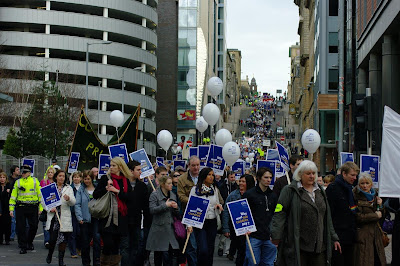
On Saturday 6th March, 10,000 teachers, lecturers, nursery staff, parents, pupils and other trade unionists poured out of Glasgow’s Kelvingrove Park, snaking their way round a mammoth route to the EIS union’s rally in the SECC.
This was the first national demo called by the EIS in decades. The overwhelming majority of the marchers had never been on a demo before. The age profile was a whole cross-section, from toddlers in buggies and primary kids, through trainee and newly qualified teachers, to bearded veterans of the profession – united in their fury at education budget cuts, whilst bankers’ bailouts, renewal of Trident weapons and bloody war cost the public a fortune.
Anger at that obscene contrast was reflected in speeches by the EIS president and others at the rally. They denounced the governments of Westminster and Holyrood for regarding these expenditures as more important than the education of our children, who represent the future, and lambasted the SNP government for now confronting children with the choice of either free school meals or smaller classes, when they had promised both and children deserve both.

SSP on the march
The EIS march is part of a campaign they have entitled “Why must our children pay?”
The SSP was the only party with a leaflet that directly dealt with the issues of the march, demanding “make the rich pay – not our kids; bail out education and all services – not bankers’ profits; 20’s plenty in any class – give our kids a chance.”
People snapped up the leaflets, smiled and murmured their agreement with the headlines, turned and quoted it to their friends as they assembled to march off.
The lively SSP contingent was joined by parents and children who fought the heroic Save Our Schools Campaign in Glasgow last year. As we marched we led the chant “Twenty’s plenty in any class – give our kids a chance”, which caught on with the crowd marching and bystanders on the pavements.
As the 10,000 trod towards the end of their marathon march to the SECC rally, we improvised an SSP “street meeting” on the pavement as they passed us! We belted out our message on a very loud PA system: “The SSP demands that the government tax the rich, to bail out education, not bankers’ profits and bankers’ bonuses.” Several sections of the march shouted back their agreement with us as they marched past, and even more contingents applauded us as they marched past. A sign of how profoundly the bankers’ bailout has changed people’s consciousness, including their open-ness to the SSP’s unashamed socialist demands.
The EIS leadership promised in speeches that this mass demo is just the start of the campaign, which is to be welcomed, and which EIS union activists and members will make sure is the case.
It is absolutely right that as the union representing 60,000 members in education they should take up the cudgels in defence of that service. But what would be tragic, and totally divisive and counter-productive, is if the EIS leadership argued for cuts in other services to save education; unity of opposition to all service cuts, combining the power and scale of members of all public sector unions and the communities they service is what is urgently needed to stop the slaughter.

Biggest civil service strike since 1987
It was therefore encouraging that an EIS representative (as well as speakers from the FBU, UNISON and STUC) addressed the 8th March strike rally in Glasgow, called during the 48-hour stoppage by all civil service workers, members of PCS.
This was the biggest civil service strike since 1987. Across the UK, over 250,000 workers brought services to a halt in tax and customs offices; Job Centres; driving centres; the Courts; the MoD; passport offices; the Scottish parliament (for the first time ever); Westminster … to name but some. 30,000 of these strikers were in Scotland.
They are overwhelmingly low-paid workers, whose partial compensation for low pay has been a modest average pension of £6,500 and a reasonable redundancy scheme – which is now under assault. The government has set in motion the legislation to slash the Civil Service Compensation Scheme, cutting the package that most workers would get on being made redundant by up to one-third, tens of thousands of pounds each. A sure sign that the Labour government (backed up quite openly by the Tories on this) want to slaughter tens of thousands of jobs on the cheap – in addition to the 100,000 already shed in the past 5 years – and usher in privatisation by making the prospect more attractive to the privateers.
The response to the 48-hour strike was absolutely overwhelming – forcing management to stoop to tricks like jetting in a handful of scab managers from Newcastle to open the Glasgow DVLA office.

Socialism in the civil service
Again, not only did SSP members in PCS play an instrumental part in building the strike, but our policies were more widely and eagerly embraced than for a long time: on the picket lines, at the PCS strike rallies in Glasgow and Dundee, and at the SSP public meeting in Glasgow after the union rally. This was a really large meeting, with over half those present attending their first ever SSP meeting. And strikers were enthusiastic in their support for our socialist aims – many commenting wryly that if only we could get a fair hearing in the media, imagine how popular our case would be – as well as our proposals on how to build public sector unity against all cuts in the immediate future.

Unity against the carnage - build 10th April Demo
Alongside a rolling programme of further industrial action by the PCS, railway workers are striking (Scotrail) and balloting for pre-General Election strikes (Network Rail). Numerous anti-cuts campaigns, involving council workers’ unions and communities, are campaigning against the brutal council cuts that loom. Already 5,000 council jobs face the chop, with hair-raising predictions of 32,000 jobs (one in every eight!) being butchered by 2014. And community centres face closure up and down Scotland.
So an immediate opportunity to tie all these strands of struggle into a rope to restrain the axe-wielders presents itself on Saturday 10th April. Scottish UNISON is calling a mass, national demonstration in Glasgow that day, in defence of public services.
SSP members in all the various trade unions – alongside other union members – need to move heaven and earth to make this an almighty display of the power of a united working class on the march, by calling on their unions to mobilise members into an event that dwarfs even the brilliant 10,000 on the EIS march.
As Labour, Tory, Lib Dem and SNP politicians sharpen their knives in a grisly pre-election competition for whose cuts are the deepest, the SSP in contrast will stand up for public sector workers and the communities that depend on public services.
We will build for a united march for public services – not private profit, demanding the governments tax the rich and bail out all public services - not bankers’ and billionaires’ profits.
We will campaign inside the unions for measures that would fund these services, protect and create jobs, and begin to re-distribute wealth from the millionaires to the millions.
Measures such as a 10% tax on every millionaire (to fund 80,000 new jobs in Scotland alone, on £25,000 a year for 3 years!); restoration of income tax on the rich to pre-Thatcher levels (83%) and likewise Corporation Tax on big companies, from the current paltry 28% to the 52% it was at before Thatcher and then New Labour made this country a tax haven for the tax-dodging rich.


A sea-change has begun in the outlook of workers in the frontline of public sector carnage by the parties that back big business and the profit system. Socialist measures – including full-blown public ownership of the entire banking sector, natural wealth, services and big industries, but with democratic control – are increasingly convincing to people whose future is under threat.
The time is ripe for the potential power of a united trade union movement to be mobilised – starting with 10th April – and for socialist demands to be boldly advanced amongst an increasingly receptive crowd of angry workers. The SSP will do its part, emboldened by the events of the past 48 hours.




By Richie Venton – SSP national workplace organiser
9th March 2010
Photos: John Lanigan

Two major trade union events in the space of 48 hours demonstrate the seething anger at public sector cuts, the potential for a united resistance across the trade unions, and the potency, increasing popularity and urgent necessity of the Scottish Socialist Party’s alternatives to this assault on jobs, services and conditions.
EIS 10,000 march
On Saturday 6th March, 10,000 teachers, lecturers, nursery staff, parents, pupils and other trade unionists poured out of Glasgow’s Kelvingrove Park, snaking their way round a mammoth route to the EIS union’s rally in the SECC.
This was the first national demo called by the EIS in decades. The overwhelming majority of the marchers had never been on a demo before. The age profile was a whole cross-section, from toddlers in buggies and primary kids, through trainee and newly qualified teachers, to bearded veterans of the profession – united in their fury at education budget cuts, whilst bankers’ bailouts, renewal of Trident weapons and bloody war cost the public a fortune.
Anger at that obscene contrast was reflected in speeches by the EIS president and others at the rally. They denounced the governments of Westminster and Holyrood for regarding these expenditures as more important than the education of our children, who represent the future, and lambasted the SNP government for now confronting children with the choice of either free school meals or smaller classes, when they had promised both and children deserve both.

SSP on the march
The EIS march is part of a campaign they have entitled “Why must our children pay?”
The SSP was the only party with a leaflet that directly dealt with the issues of the march, demanding “make the rich pay – not our kids; bail out education and all services – not bankers’ profits; 20’s plenty in any class – give our kids a chance.”
People snapped up the leaflets, smiled and murmured their agreement with the headlines, turned and quoted it to their friends as they assembled to march off.
The lively SSP contingent was joined by parents and children who fought the heroic Save Our Schools Campaign in Glasgow last year. As we marched we led the chant “Twenty’s plenty in any class – give our kids a chance”, which caught on with the crowd marching and bystanders on the pavements.
As the 10,000 trod towards the end of their marathon march to the SECC rally, we improvised an SSP “street meeting” on the pavement as they passed us! We belted out our message on a very loud PA system: “The SSP demands that the government tax the rich, to bail out education, not bankers’ profits and bankers’ bonuses.” Several sections of the march shouted back their agreement with us as they marched past, and even more contingents applauded us as they marched past. A sign of how profoundly the bankers’ bailout has changed people’s consciousness, including their open-ness to the SSP’s unashamed socialist demands.
The EIS leadership promised in speeches that this mass demo is just the start of the campaign, which is to be welcomed, and which EIS union activists and members will make sure is the case.
It is absolutely right that as the union representing 60,000 members in education they should take up the cudgels in defence of that service. But what would be tragic, and totally divisive and counter-productive, is if the EIS leadership argued for cuts in other services to save education; unity of opposition to all service cuts, combining the power and scale of members of all public sector unions and the communities they service is what is urgently needed to stop the slaughter.

Biggest civil service strike since 1987
It was therefore encouraging that an EIS representative (as well as speakers from the FBU, UNISON and STUC) addressed the 8th March strike rally in Glasgow, called during the 48-hour stoppage by all civil service workers, members of PCS.
This was the biggest civil service strike since 1987. Across the UK, over 250,000 workers brought services to a halt in tax and customs offices; Job Centres; driving centres; the Courts; the MoD; passport offices; the Scottish parliament (for the first time ever); Westminster … to name but some. 30,000 of these strikers were in Scotland.
They are overwhelmingly low-paid workers, whose partial compensation for low pay has been a modest average pension of £6,500 and a reasonable redundancy scheme – which is now under assault. The government has set in motion the legislation to slash the Civil Service Compensation Scheme, cutting the package that most workers would get on being made redundant by up to one-third, tens of thousands of pounds each. A sure sign that the Labour government (backed up quite openly by the Tories on this) want to slaughter tens of thousands of jobs on the cheap – in addition to the 100,000 already shed in the past 5 years – and usher in privatisation by making the prospect more attractive to the privateers.
The response to the 48-hour strike was absolutely overwhelming – forcing management to stoop to tricks like jetting in a handful of scab managers from Newcastle to open the Glasgow DVLA office.

Socialism in the civil service
Again, not only did SSP members in PCS play an instrumental part in building the strike, but our policies were more widely and eagerly embraced than for a long time: on the picket lines, at the PCS strike rallies in Glasgow and Dundee, and at the SSP public meeting in Glasgow after the union rally. This was a really large meeting, with over half those present attending their first ever SSP meeting. And strikers were enthusiastic in their support for our socialist aims – many commenting wryly that if only we could get a fair hearing in the media, imagine how popular our case would be – as well as our proposals on how to build public sector unity against all cuts in the immediate future.

Unity against the carnage - build 10th April Demo
Alongside a rolling programme of further industrial action by the PCS, railway workers are striking (Scotrail) and balloting for pre-General Election strikes (Network Rail). Numerous anti-cuts campaigns, involving council workers’ unions and communities, are campaigning against the brutal council cuts that loom. Already 5,000 council jobs face the chop, with hair-raising predictions of 32,000 jobs (one in every eight!) being butchered by 2014. And community centres face closure up and down Scotland.
So an immediate opportunity to tie all these strands of struggle into a rope to restrain the axe-wielders presents itself on Saturday 10th April. Scottish UNISON is calling a mass, national demonstration in Glasgow that day, in defence of public services.
SSP members in all the various trade unions – alongside other union members – need to move heaven and earth to make this an almighty display of the power of a united working class on the march, by calling on their unions to mobilise members into an event that dwarfs even the brilliant 10,000 on the EIS march.
As Labour, Tory, Lib Dem and SNP politicians sharpen their knives in a grisly pre-election competition for whose cuts are the deepest, the SSP in contrast will stand up for public sector workers and the communities that depend on public services.
We will build for a united march for public services – not private profit, demanding the governments tax the rich and bail out all public services - not bankers’ and billionaires’ profits.
We will campaign inside the unions for measures that would fund these services, protect and create jobs, and begin to re-distribute wealth from the millionaires to the millions.
Measures such as a 10% tax on every millionaire (to fund 80,000 new jobs in Scotland alone, on £25,000 a year for 3 years!); restoration of income tax on the rich to pre-Thatcher levels (83%) and likewise Corporation Tax on big companies, from the current paltry 28% to the 52% it was at before Thatcher and then New Labour made this country a tax haven for the tax-dodging rich.


A sea-change has begun in the outlook of workers in the frontline of public sector carnage by the parties that back big business and the profit system. Socialist measures – including full-blown public ownership of the entire banking sector, natural wealth, services and big industries, but with democratic control – are increasingly convincing to people whose future is under threat.
The time is ripe for the potential power of a united trade union movement to be mobilised – starting with 10th April – and for socialist demands to be boldly advanced amongst an increasingly receptive crowd of angry workers. The SSP will do its part, emboldened by the events of the past 48 hours.


Friday, 18 May 2007
WILLIE TELFER MAKES BIG IMPACT AT PCS CONFERENCE
Scottish Socialist Party members who are delegates to this week’s PCS national conference in Brighton have made a huge impact.
They’re speaking on issues like privatisation, and are moving a major motion to commit the union to an £8-an-hour minimum wage for all workers and trainees over 16.
Colin Fox, the Scottish Socialist Party’s national convener, was a guest speaker at the Department of Transport PCS group conference on our case for free public transport - which was then debated and agreed as policy, moved by Campsie Branch SSP member, and Twechar Housing campaigner, Willie Telfer and supported by the union’s Group Executive Committee.

Willie has also been re-elected as UK-wide Assistant Group Secretary of the union in the transport section.
Meantime longstanding socialist and SSP member John Jamieson has been elected to the PCS national executive committee, as part of an almost total clean sweep for the Democracy Alliance of socialists and democrats.
And our efforts are not restricted to the PCS. At the Fire Brigades Union national conference Scottish Socialist Party members were at the heart of a solidarity collection for the Sunvic strikers, raising £1,500 to help sustain their battle against vicious treatment by scab-hiring bosses.
And in a debate around the FBU and political links, during which a motion to re-affiliate the union to New Labour was overwhelmingly defeated, SSP member Jimmy Scott successfully moved an amendment which re-stated the FBU’s commitment to “a socialist form of society”, a longstanding FBU rule-book clause which collides with New Labour’s whole philosophy and practice.
They’re speaking on issues like privatisation, and are moving a major motion to commit the union to an £8-an-hour minimum wage for all workers and trainees over 16.
Colin Fox, the Scottish Socialist Party’s national convener, was a guest speaker at the Department of Transport PCS group conference on our case for free public transport - which was then debated and agreed as policy, moved by Campsie Branch SSP member, and Twechar Housing campaigner, Willie Telfer and supported by the union’s Group Executive Committee.

Willie has also been re-elected as UK-wide Assistant Group Secretary of the union in the transport section.
Meantime longstanding socialist and SSP member John Jamieson has been elected to the PCS national executive committee, as part of an almost total clean sweep for the Democracy Alliance of socialists and democrats.
And our efforts are not restricted to the PCS. At the Fire Brigades Union national conference Scottish Socialist Party members were at the heart of a solidarity collection for the Sunvic strikers, raising £1,500 to help sustain their battle against vicious treatment by scab-hiring bosses.
And in a debate around the FBU and political links, during which a motion to re-affiliate the union to New Labour was overwhelmingly defeated, SSP member Jimmy Scott successfully moved an amendment which re-stated the FBU’s commitment to “a socialist form of society”, a longstanding FBU rule-book clause which collides with New Labour’s whole philosophy and practice.
Subscribe to:
Posts (Atom)