Showing posts with label Scottish. Show all posts

Monday, 14 October 2013

Yes Scotland: a 16 year old writes...

Saying Yes to Scottish Independence: An opportunity for social justice.

16 year old Michael Scott, who will vote in next year's Independence referendum, writes about why he will vote YES.

Work as if you live in the early days of a better nation - Alasdair Gray[1]

Do you want the chance to create a better Scotland? In the 2014 referendum on independence you’ll get that opportunity. Given the choice, I for one will be saying yes. Too many important matters are still controlled, and I would argue controlled badly, by Westminster. The democratic deficit and the ever-growing chasm between the values of the MPs in London and the people of Scotland are now impossible to ignore. Independence offers the possibility of a different political road; the case for change is strong.


First and foremost there is a lack of democracy for Scottish voters within the current political union. Over the last 30 years we have been governed, more often than not, by a political party which the majority of people didn’t vote for. In the most recent general election, only 11% of those eligible to vote in Scotland voted for the Conservative Party and only 23% voted for the Conservatives and Liberals combined[2]. The House of Commons’ report, on the 2010 general election results, notes the “complete detachment”2(p14) of Scotland from political trends in England and Wales. This political detachment is both determined by and reflected in the different socioeconomic values displayed by Westminster and Holyrood.

A number of important matters of government are already devolved including education and health and where we have had the power to make our own decisions we have chosen radically different policies. A good example of this is the difference between the management of the NHS in Scotland compared with what is happening to the NHS in England following the introduction of the new Health and Social Care Act. While the former Scottish Secretary of State for Health has categorically stated her opposition to private sector involvement in healthcare[3], the new English health act has sown the seeds of privatisation within the NHS in England[4]. Similarly in education there is a distinct difference in attitudes towards undergraduate tuition fees between the two governments. On the one hand, First Minister Alex Salmond has been unequivocal in his opposition to fees stating “The rocks will melt with the sun before I allow tuition fees to be imposed on Scottish students”[5] while on the other hand the Coalition government has allowed universities in the rest of the UK to charge fees of up to £9000 a year.[6]

Unfortunately however, under devolution a number of significant matters are still controlled by Westminster including the economy, welfare, and defence. Although Scotland has a traditional commitment to centre left political parties2, lack of control over these important areas means that substantial parts of our society can be determined by policies that the majority of the population are unlikely to agree with. For example, it is hard to imagine the combination of swingeing cuts to the welfare budget affecting the most vulnerable in our society[7] and reduction of the top rate of tax for high earners[8] being popular with the majority of Scottish voters. Similarly it has been estimated that 73% of Scots are opposed to government plans to renew Trident. And yet, these decisions and other important matters are imposed on us by a government which less than a quarter of the eligible Scottish electorate has voted for.


Finally, I would like to allay some of the main fears surrounding independence. The three main arguments against Scottish Independence seem to consist of us being too small, too stupid and too poor to stand on our own two feet.[9] Let me tackle each of these in turn. First, as to being too small, we don’t have to look too far afield to see many small countries prospering. A prime example of this would be Norway, which, like Scotland, has a population of about 5 million and off shore oil. However, unlike Scotland, Norway has complete control of the revenue of its oil resource and as a result has been able to use the accumulated surplus (approx £368bn) as a pension fund.[10] Another example of a small economy thriving is that of Iceland, which, with a population of just over 300,000, is bucking the European trend in terms of economic recovery from the financial crisis.[11]

 Secondly with respect to being too inexperienced to run our own affairs I’d argue that we already run many important national matters from Holyrood successfully including health, education and justice.

 Thirdly, as to us being too poor, a recent New Statesman article stated “not only does Scotland more than pay its way in the Union, but its overall fiscal position would actually be stronger as a fully sovereign nation”[12] The author of this article goes on to point out that although Scots represent just 8.4% of the UK’s total population they contribute 9.4% to its tax revenues which is equivalent to an extra £1000 for every person in Scotland relative to the contribution of others in the UK.

 An argument against Scottish Independence with which I do have sympathy is that it will ultimately decrease the chance of achieving a more socially democratic society on a UK wide basis. In the short-term I appreciate that the loss of Scottish voters may result in an increased proportion of right wing political representatives in the UK parliament. However, in the longer term I hope that having a neighbouring, flourishing, social democratic society may more powerfully change political attitudes across the rest of the UK than we have been able to do in recent years.

In conclusion, I would argue that fear of change is the only thing holding us back. Some change however, is good; and if we work as if we are in the early days of a better nation then this change will be for the good and the opportunity to create a more socially just society will be realised.


REFERENCES

[1] Gray A. Work as if you live in the early days of a better nation. Herald Scotland. May 5 2007. http://www.heraldscotland.com/work-as-if-you-live-in-the-early-days-of-a-better-nation-1.827519 (accessed 15 September 2012).


[2] Electoral Reform Society. The UK General Election 2010: In depth. House of Commons. 2010.


[3] Torrance D. Scottish Health Secretary: England will end NHS as we know it. The Guardian. March 22 2012 http://www.guardian.co.uk/healthcare-network/2011/mar/22/scottish-health-secretary-england-ending-nhs (accessed 15 September 2012)


[4] Campbell D. BMA's new leader: 'There's no evidence that a part-privatised NHS runs better'. The Guardian. August 31 2012. http://www.guardian.co.uk/society/2012/aug/31/bma-leader-nhs-privatisation (accessed 15 September 2012)


[5] BBC News. SNP Conference: Salmond in free education pledge. http://www.bbc.co.uk/news/uk-scotland-12711509 (accessed 15 September 2012)


[6] BBC News. Students face tuition fees rising to £9000. http://www.bbc.co.uk/news/education-11677862 (accessed 15 September 2012)


[7] UN urged to monitor welfare cuts. The HeraldScotland. September 21 2012. http://www.heraldscotland.com/news/home-news/un-urged-to-monitor-welfare-cuts.18934095 (accessed 21 September 2012)


[8] Stewart H. Budget 2012: 50p tax rate scrapped and allowance raised. The Guardian. March 21 2012 http://www.guardian.co.uk/uk/2012/mar/21/budget-2012-50p-tax-rate-scrapped-allowances (accessed 15 September 2012)


[9]Scottish Independence: It’ll Cost You. The Economist. http://www.economist.com/node/21552564 (accessed 21 September 2012)


[10]Wikipedia. The Government Pension Fund of Norway. http://en.wikipedia.org/wiki/The_Government_Pension_Fund_of_Norway (accessed 21 September 2012)


[11] Lyall S. A Bruised Iceland Heals Amid Europe’s Malaise. New York Times. July 12 2012. http://www.nytimes.com/2012/07/08/world/europe/icelands-economy-is-mending-amid-europes-malaise.html?pagewanted=all&_r=0 (accessed 21 September 2012).


[12] Maxwell J. Enough of The Scottish subsidy myth. The New Statesman. November 06 2011. http://www.newstatesman.com/blogs/the-staggers/2011/11/scotland-12288-union-public (accessed 21 September 2012).

Wednesday, 8 May 2013

Independence:

SSP Campsie blogger, Neil Scott "Labour Commentators Are Wrong to Pull Independence Debate Ultra-Right" HERE via @huffingtonpost

Sunday, 5 May 2013

A fair Scotland?


Cooperation, democracy, fairness, internationalism, choice. Scotland's future after the 2014 referendum HERE

Saturday, 20 April 2013

Sunday, 10 February 2013

One reason why I support Independence...

By Neil Scott, Campsie Branch.

How do I explain my want for an independent Scotland? Ok. Lets do that using one example. Excess.

It's clear I am a socialist, so surplus in my independent Scotland would be used to ensure those with little access to something they need, get it. Excess or surplus or profit would not bolster the bank accounts of those who have so much they will never use it.

In Scotland, over 2000 people MORE die in the four winter months than they do in the previous four and the following four. A lot of those deaths are because of hypothermia in the home. This is in a country in which we have an excess of oil and an excess of electricity produced. This surplus is not given to our pensioners and poor to ensure they live through these harsh Scottish months. Both are sold in London or through a majority of London based companies for the profit boosting of the top six power companies who make more than £30 billion a year to cushion billionaires from the harsh winters on their yachts in the Carribean or at the most local, their well heated second, third or forth homes they keep in Scotland for the Grouse shoot or a wee visit at Hogmanay.

£30 billion a year that is mostly generated in Scotland through our excess of power. And this figure does not factor in the oil drained from our shores to bolster those bank accounts of the millionaires and billionaires who can afford to invest in the oil companies. Money they will in all probability never spend, while the lives of the poor and old are sacrificed.

Fighting this greed and fighting to share out our plentiful resources to ensure people have better, longer and more productive lives has not happened with Scotland in the UK. The UK is not OK for Scotand's vulnerable.

Scotland has voted continuously and decisively for a more socially just system since the days of Thatcher and before. But what have we had? Our budgets and welfare controlled by the Tories, Liberal Democrats and New Labour- all who have deep relationships with the power and oil profiteers.

None of the above really want to ensure our pensioners and vulnerable are safe and warm. In fact all of the above support welfare cuts and bleeding more money from the most vulnerable of our people in order to boost profits and pay off bankers.

Can staying in the UK change this? The evidence of the past forty years is evidence itself.

Can an Independent Scotland change this? I believe so, as the people of Scotland have been proven to vote for fairness and increasingly so, from election to election.

Monday, 30 April 2012

Elect a socialist in East Dunbartonshire...

place a number 1 beside the socialist candidate!

(click on leaflet for larger version)


Kirkintilloch East and Twechar  Willie Telfer:

The “mainstream” political parties are draining Kirkintilloch, East Dunbartonshire, Scotland and the UK in general of taxes that should be going towards helping people.  In England, the Tories and Liberal Democrats have overseen the selloff of the NHS to the likes of SERCO, a company who are involved in military and nuclear weapons contracts, detention centres and prisons. This hardly fits with the Doctor mantra, "Do no harm..."  Our local council – ran by an unholy alliance of Tories and New Labour, (and still suffering from the neglect of the previous Liberal Democrat led administration) have overseen the paying off of vital council staff from classroom assistants through to librarians, yet pour millions of our Council Tax into paying interest to corporations who are profiteering from schools and hospital builds.  The council is the first line of defence from the profiteers who are trying to turn our services into “for profit organisations,” rather than “care, education and fairness.”  An SSP councillor will fight to ensure your taxes are spent on vital services rather than servicing profits.
Scottish Socialist Party councillors will always put first the interests of local people and; communities; Scottish Socialist Party councillors will demand and will present balanced ‘No Cuts’ budgets and unlike other parties, SSP councillors are prepared to do whatever it takes to deliver a better deal for local people through protected and enhanced services and public sector jobs.


Bishopbriggs South   Mark Callaghan:

I am 46, involved in both the Healthy Living Program and my local Town Hall

As a socialist, I believe in a system that help people not one that is about a minority of people making extortionate profits by keeping people poor.  If elected, I will always put first the interests of local people and communities and will present a balanced ‘No Cuts’ budget – budgets for the people, not the bankers.

Unlike other parties, all SSP councillors are prepared to campaign to deliver a better deal for local people through protected and enhanced services and public sector jobs.

SSP Councillors will stand beside communities being attacked and will defend them in a practical way both inside the council Chamber and outside.


Neil Scott, Bearsden North.

A local teacher, Neil Scott, is standing in the May elections against what he sees as the mismanagement of Council money and unnecessary cuts.  He said in a statement, “East Dunbartonshire has, in recent years, had the misfortune of having had a Liberal Democrat Council followed by a coalition of Labour and Tories.  The mishandling of the council by these three versions of the same thing has seen an attempt to close schools in the past two years; terrible deals with corporations that have meant millions of pounds of our Council Tax money being given over to massive PPP/PFI “Guaranteed returns on investment” for minimum outlay; a decimation of our local services from Libraries through to schools, and more.  If any of these parties gain the council in May, there will be more of the same, and in fact the deferred closure of East Dunbartonshire Schools will go ahead.

As a father and a teacher I have a different vision for East Dunbartonshire services.  Our area is a well off council area, one in which money could be invested in our services rather than further job-losses and cuts.  I see a clear need to renegotiate PPP/PFI deals.  Some of these venture capitalists are making millions of pounds of our tax money with investments of a few hundred pounds.  I see East Dunbartonshire being a place of opportunity for all; a place where our money is invested in real jobs and services which will help stimulate the Scottish economy.  The real drivers of any economy are people.  The profits creamed off by corporations from our Council tax should be reclaimed and invested in real jobs and in our people.”


Sunday, 11 March 2012

Local teacher, Neil Scott to stand in Bearsden North in May's council election

Statement:


“East Dunbartonshire has, in recent years, had the misfortune of having had a Liberal Democrat Council followed by a coalition of Labour and Tories. The mishandling of the council by these three versions of the same thing has seen an attempt to close schools in the past two years; terrible deals with corporations that have meant millions of pounds of our Council Tax money being given over to massive PPP/PFI “Guaranteed returns on investment” for minimum outlay; a decimation of our local services from Libraries through to schools, and more. If any of these parties gain the council in May, there will be more of the same, and in fact the deferred closure of East Dunbartonshire Schools will go ahead.

 As a father and a teacher I have a different vision for East Dunbartonshire services. Our area is a well off council area, one in which money could be invested in our services rather than further job-losses and cuts. I see a clear need to renegotiate PPP/PFI deals. Some of these venture capitalists are making millions of pounds of our tax money with investments of a few hundred pounds. I see East Dunbartonshire being a place of opportunity for all; a place where our money is invested in real jobs and services which will help stimulate the Scottish economy. The real drivers of any economy are people. The profits creamed off by corporations from our Council tax should be reclaimed and invested in real jobs and in our people.”

Sunday, 26 February 2012

Scottish Independence - the Chelsea set accuse Scotland of "Munching through taxes like deep-fried Mars-bars..."

In reaction to this article in the "Kensington and Chelsea Today" newspaper, Dave Coull wrote the following response on Facebook. With his kind permission, I reproduce this below.

 "Some towns got big because they produced something. For instance, Bradford's textile mills, Stoke-on-Trent's potteries, Birmingham's engineering workshops, Sheffield's fine quality steel products, Glasgow's shipbuilding, and so on. Other towns got big because the king was there. London is a town that got big because the king was there.

By the beginning of modern times London was already big. The formation of the United Kingdom made it even bigger. Precisely BECAUSE it was the centre of government, it became the "centre" of the biggest free trade area in all of Europe, and the capital of the most highly centralised state in all of Europe. The growth of the British Empire made it also the centre of government of the biggest empire on Earth. Even after the Empire became the Commonwealth, London remained the centre of the Sterling area. The centre of the world empire remained a centre of world business out of sheer force of habit, because businessmen for the most part lack the imagination to do things differently.

London remained a centre of world banking, a centre for the offices of multi-national companies, and all of this happened because, to begin with, the king was there. So the government was there. So all the companies who wanted to get contracts from the government were there. This process is continuing to this very day. Many, many billions of pounds of OUR money is being spent on glorifying London still further for the Olympics.

Of course they will try to tell you it is for the benefit of all of us, but the truth is, the Olympics are for the benefit of London. I lived in London for twelve years, working as a bricklayer. That's a useful job, you might think. But what was I building? Sometimes it was office blocks for the millions of pen-pushing bureaucrats. Sometimes it was houses for the millions of pen-pushing bureaucrats. Sometimes it was houses for the people who provided services for the millions of pen-pushing bureaucrats.

Hardly anybody at all in London actually PRODUCES anything at all. They are all there because the government is there. This entire mega city is just one great big pile of bureaucracy. This idiot claims their taxes subsudize us. The truth is, everybody in London is subsidized by the taxes paid by the rest of the UK."

Dave Coull was born in 1941, and left school to start full time work at the age of 15. He worked at many different jobs, always for a weekly wage rather than a salary, and mostly in the building industry, as a bricklayer. Dave has been active in various campaigns but has always avoided joining any political party (unless you count anarchists as a party). While acting as a site steward for building workers in London, Dave was sacked, which led to a (successful) unofficial strike by his fellow workers for his reinstatement. Nowadays Dave has slowed down a bit and tends to feel it’s mostly up to younger folk to carry on the fight.

Wednesday, 8 June 2011

Scottish Education- A Socialist Response to Curriculum for Excellence

On the Eve of the EIS Conference, SFST member, Allan Armstrong analyses the CfE

The combination of the over 40% rejection of the latest EIS/COSLA/SEED pay and conditions deal, with the publication of the decisions of the the McCormac Review, means that socialist teachers are now presented with a real opportunity to advance a far-reaching alternative. Otherwise, if the SEED/COSLA and Moray Place get their way, teachers only face increased demoralisation and depression as greater and greater burdens are placed upon our shoulders, only to meet fewer and fewer of our students’ real educational needs.

Perhaps, the employers’ greatest victory, stemming from the 2001 McCrone Agreement, was the EIS giving up any critical assessment of ongoing governments’ educational counter-reforms. In the late 60’s and 70’s, many classroom teachers were avid participants in educational debate. Publishers, including Penguin, issued regular Education Specials. In these the latest ideas - some decidedly whacky, some divorced from any classroom experience, but many very stimulating - were read and debated by teachers, especially socialist teachers, many of whom entered education after ‘68’.

In secondary education, as recently as the 1990’s, there were vibrant subject organisations, such as the Association of Media Education (Scotland), in which classroom teachers eagerly participated, discussed and debated the latest developments and practice, without any thought of advancing their careers beyond the classroom. These organisations weren’t insular and also sought out the most stimulating external speakers.

However, the SED and SEED completely failed to build on all this classroom teachers’ knowledge and experience, whilst the EIS leadership never took radical educational reform seriously - it was too associated with precisely those who contested them on pay and conditions.
Reforming Scottish education took a different course. ‘Experts’ were drawn from the senior promoted staff in the universities and colleges of education, aided by selected promoted teachers. They were prepared to accept the latest top-down changes in return for their own rapid career enhancement. Initially, there were consultation exercises, like that conducted around Higher Still. However, when classroom teachers challenged these top-down initiatives, they were just ignored. Higher Still was launched to a great fanfare, and crashed spectacularly in the first year of the new examinations in 2000.

Primary teachers offered similar warnings over National Testing. This would result in young school students being trained to pass through the requisite hoops (the national tests), at the cost of gaining the more rounded knowledge that could advance their education. Eventually, even the HMI’s (now employed solely to promote the latest government initiatives, and to cow and police teachers into doing so) cottoned on to what classroom teachers had long being saying. They eventually realised that the National Testing they had been pushing down primary teachers’ throats would have to go.

Therefore. the SEED came up with a new catch-all educational counter-reform to cover schooling from 3-18 - the Curriculum for Excellence (CfE). A key feature of CfE has been the total non-involvement of class teachers in its formulation or development. The SEED decided to avoid the challenges from classroom practioners they had faced over their earlier reforms. Furthermore, another key aspect of CfE has been to make the actual nature of the changes as vague as possible. This means the SEED can continually change the goalposts, revealing new changes as they see fit, knowing that classroom teachers have been disarmed in advance, since they have never had any input into the process.

Following earlier precedents, CfE produced its own round of jargon (what was once essential knowledge for would-be careerists is now just as important for those trying to get a permanent contract). However, every classroom teacher realises that the four ‘capacities’ are a burdensome add-on extra, which do not help actual educational practice. Does anybody know one person in school, charged with promoting ‘responsible citiizens’ throughout the curriculum, who took the opportunity of all the brouhaha surrounding the recent royal wedding to promote discussion in school on what being a citizen actually means - as opposed to being a docile subject? For the authorities and school management ‘capacities’ are just another addition to their armoury of control - monitoring and measuring our compliance by ticking boxes and through regular teacher appraisal.

As local education offices and schools develop an ever-extended and privileged hierarchy of managerial posts, these people, far divorced from classroom realities, have to produce longer and longer paper trails to provide evidence to their immediate superiors, that they are in control of things. Since there is continuous downward managerial pressure, every effort is made to ensure, at each subordinate level, that the requirements demanded are met on paper. However, as the paperwork is passed up the managerial hierarchy, it reflects less and less of the reality in the classroom.

Our new managerial stalinists face similar problems to their now departed predecessors in the old USSR. At present, most teachers remain committed enough to the job that they try to deflect all the top-down imposed crap, the better to get on with the real job of teaching. However, if the McCormac Review were to be ‘successfully’ imposed, schools would likely become dysfunctional workplaces, where “they pretend to pay us, and we pretend to work”. And school students confronted with more and more meaningless school work, and fewer and fewer decent job prospects, would be even more disaffected - a recipe for failure.

Most teachers would recognise the need for some administrative jobs to enhance our work in the classroom (e.g. curriculum development, pastoral care, dealing with necessary agencies). However, the reality underlying many of the new promoted posts is that they create work that detracts from the job of teaching. The more elaborate and dictatorial the managerial hierarchies weighing down upon teachers, the less teachers have meaningful control, and the less effective is the education we provide.

So what can teachers do? Developing meaningful education for our students means asserting teacher control over classroom education. Nobody has more interests in providing effective learning than teachers, since we soon know to our cost whenever we are unable to do this. The massively increased managerial pressures resulting from the McCormac Review, coupled to the worsened conditions and the pay freeze, have educational failure and breakdown written all over them. Furthermore, Scottish Labour*, the SNP and the Tories all have plans to protect the more privileged, especially from the middle class, from the consequences of their planned educational, social and economic measures. They want to develop a hierarchy of state funded private schools (which can set their own curriculum, pay and conditions) leaving behind a growing number of sink schools.

And central of all their plans is CfE. Here is the Wikipedia assessment of how teachers currently view CfE:-

“Many within the Scottish teaching profession, including the teacher's union EIS and it's members, believe that the Curriculum for Excellence is too vague, in particular with regards to its 'outcomes and experiences'. There exists a fear that this vague factor will result in teachers not knowing what is expected of them in the classroom. This has been further exacerbated by the confusion over assessment. As the implementation of the CfE continues, then assessment guidelines will be published. This includes assessment on literacy and numeracy from all subjects within Secondary Schools. The time required to complete such expectations risk taking time away from teaching subject content.”

And here is the official EIS response:-

‘EIS general secretary Ronnie Smith said the union, together with most teachers, supported the aims of the Curriculum for Excellence.

But he added they had "a number of concerns about how the process of implementation is progressing"’.

(http://news.bbc.co.uk/1/hi/scotland/8039474.stm)

This reflects the fact that the EIS leadership, under McCrone, gave up the right to meaningfully criticise the nature of government educational policy. They can only confine themselves to negotiating the terms of its implementation (and thy have been lousy at doing that too!) This helps to explain why so much of the Scottish Educational Journal is indistinguishable from any SEED or Local Authority material promoting the latest government ‘education’ initiative. Moray Place has just become an additional personnel management service for our bosses.

On those occasions, Moray Place has been forced into taking action, it as been of a token nature, designed to let off steam. At the same time, as Moray Place was organising for teachers to attend the TUC’s display of trade union ‘unity’ against the cuts on March 26th, it was, at the same time, planning to be the first union to break that unity, with its latest sell-out. Putting demands on Moray Place is not sufficient. Socialists must argue the case now for independent action, which can not be recuperated and sold out by union officials. It may take a little time yet before we can make the sort of breakthrough achieved in 1975, with mass independent (unofficial) action, but the ground should be prepared. Scottish Rank & File Teachers were formed in1972, two years before this major breakthrough.

Therefore it is the gap between what teachers already clearly understand (see Wikipedia entry) and what Ronnie Smith and Moray Place oppose, that socialist teachers should address.

As a far from comprehensive starter, I suggest that the socialist teachers could initiate discussion around the following points:-

a) oppose the CfE on educational grounds
b) promote class teacher-controlled educational organisations (like the original AMES) to develop a meaningful curriculum and promote good educational material (pressing for resources and time from the SEED and Local Authorities - probably much cheaper than the current top- down, over-promoted and wasteful system, e.g. never ending costly glossy brochures, which just lie in cupboards, or are taken out before interviews, after their first in-service day airing!)
c) argue for democratising schools, with the scope and nature of necessary non-classroom work under class teacher control. Department (secondary) or Years Group (primary) organisers to be elected by the class teachers concerned (this would cut down unnecessary bureaucracy work to a mimimum) and to be subject to re- election.
d) reform the EIS, so all officials are directly elected, subject to regular re- election, recruited from amongst classroom teachers, and receive the average pay of classroom teachers (the impending replacement of the truly dire Ronnie Smith provides an opportunity to raise this issue).

Yes, this may seem like a ‘return to 1968’, however, I think it is such radical l thinking that is now required in the face of the ongoing economic, social and educational crisis we now face. Tahrir Square in Cairo may have seemed quite far away. However, when young students, workers and unemployed in Spain are joining daily protests in public squares, maybe ‘the spirit of 2011’ will once more take off across the world where ‘the spirit of 68’ left off. I still remember occupying Moray Place in 1974, as part of the movement which turned Scottish education upside down at the time. Bob Dylan may be 70, but perhaps ‘The Times They Are A’Changing’ again!

Allan Armstrong, 30.5.11

Saturday, 4 September 2010

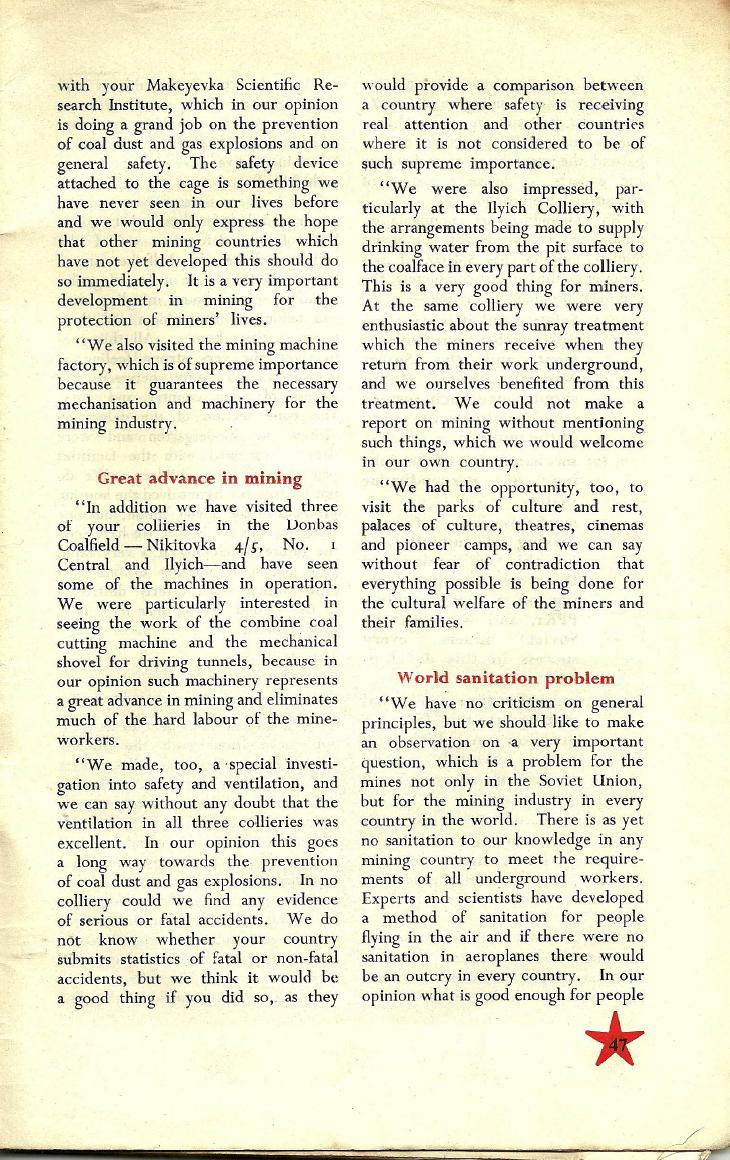
Scottish Miners in the Soviet Union - August 1953

Probably one of the most interesting pamphlets on the Soviet Union series I have been adding - this is an account - in detail - of a delegation to the Soviet union by Scottish Mine Workers in 1953.  there is lots of technical information of interest to the mining industry - but of interest to me is mention of 5 year plans - and the visits to schools, hospitals and farms.

More pamphlets from the past HERE

More on the Soviet Union:
Harry Pollitt's "The People on the March" HERE
Abbie Bakan's "The Great Lie" HERE