New episode of the SSP Campsie podcast HERE
Contact us email – eastdunbartonshiressp@hotmail.co.uk , twitter – @sspcampsie or leave a message by phoning or texting– 075 413 925 22 – your standard charges apply!

Sunday, 19 September 2010


Thursday, 16 September 2010
Guest blogger: FIGHTING THE CUTS: fine words and defiant deeds
By Richie Venton, SSP national workplace organiser 14 Sept 2010

The fiery speeches at the TUC congress in Manchester dominated the media headlines. People at work talked about the prospect of widespread strikes. Women at the school gates picking up primary kids commented “we’re all going to be out on strike”. Many workers relished the idea of action, together. And the very fact they had noticed the TUC debate on the ConDem cuts is a reminder of the potential power of the trade unions to give a lead. That potential now needs to be tapped into through action, not just fiery speeches.
The devastation looming towards communities and workforces – both public- and private-sector –is beginning to sink into the minds of millions. In recent days, a series of hard-hitting facts and studies have exposed the realities we face, unless a mighty movement of rallies, demonstrations and ultimately coordinated strikes (alongside civil disobedience) is built to halt the Millionaires’ Cabinet.
Poorest hit hardest
The planned slaughter will hit the poorest hardest – and ratchet up the obscene levels of inequality still further. The poorest 10 per cent of the population will lose 13 times more by the cuts than the richest 10 per cent.
Pensioners, low-paid families, the sick and unemployed will pay a terrible price for a crisis created by the bankers and billionaires. Meantime profits, perks and downright pilfering of public funds by top bankers, bosses and bureaucrats in quangos and the public sector run riot.
As the TUC warned, a million jobs could be wiped out if the Tory-LibDem butchers get their way. Around 72 per cent of the cuts will be borne by women, who make up 65per cent of public sector workers. Young people will be hammered – with a million under-24s already on the scrapheap.
And the catastrophic loss of 10,000 Scottish jobs threatened in the shipyards as a result of Defence cuts is a harsh reminder that public sector cuts mean private sector redundancies too.
Shift in opinion
Since the day they were NOT elected, the Twin Tories have bombarded the population with daily propaganda that the cuts are necessary, unavoidable, and therefore inevitable – all for our own good! That makes it all the more remarkable that in a Populous poll for the Times newspaper, 3 out of 4 people reject the ConDem cuts strategy. That is a powerful starting point for the trade union leaders - who have rightly lacerated “the demolition government” - to mount a serious, systematic campaign not just of explanation, but also of united action.
Winter of our discontent
The media headlines about the TUC debate on cuts painted lurid - and mostly viciously inaccurate - pictures of the 1979-80 ‘Winter of Discontent’. Their aim was to scare the living daylights out of the middle class, and even sections of workers, with images of rubbish piling up in the streets and the dead left unburied … to try and stop a wave of support for the “coordinated campaigning and industrial action” that the TUC motion calls for.
Unity is strength
We need a sober, serious examination of some key issues if we are to help defeat the wild axe-men of Westminster, not to mention the little axe-wielders in Holyrood and every one of Scotland’s 32 councils.
Unity against the cuts is critical. Tory Chancellor Osborne’s vicious, oily lie that “we are all in this together” is ripped apart by the facts, as reinforced by the various recent reports. The rich will get richer, the rest of us poorer, if they’re not stopped. Divisions between workers and those on benefits, private- and public-sector workers, pensioners and pupils, would be the death of any resistance – and the government are relentlessly trying to whip up such division.
So the motion agreed (with only the one Airline Pilates’ Association delegate against!) at the TUC, - which has 7 million trade unionists in its ranks - for coordinated campaigning and action is extremely welcome to all who care for the defence of a half-civilised society.
Trade union right-wing hesitate
But what did the central leaders of the TUC actually agree? Here there’s a distinction to be made between left and right union leaders.
The right-wing of the unions has stubbornly resisted calls for a demo in London on 23 October, days after the government’s Comprehensive Spending Review. They instead talk of a demo in March – when the cuts will be signed, sealed and delivered!
Contrary to the more colourful media headlines, they mainly want “coordination of a campaign” against the government’s arguments – and that in itself is a vital part of the battle; to build on the growing scepticism about the case for the cuts; to demolish it in the minds of millions, and critically to put forward a convincing economic alternative.
But the reluctance of the TUC right-wing to go for actual action, sooner rather than later – even initially in the form of a demo – should ring alarm bells for trade union members. It reveals an unhealthy reliance on “fine words” convincing the government to change tack, when we all know this ruthless capitalist coalition will only retreat if confronted by a mass rebellion.
Underlying this approach is a mind-boggling reliance on working for the return of a Labour government – as blurted out openly by Derek Simpson of the country’s biggest union, UNITE. As if we hadn’t just experienced 13 years of New Labour! And what are workers and communities meant to do for the next 4 years, ‘til the next election?
Poll tax rebellion
Top TUC leaders, like Brendan Barber, grab the headlines with talk of a rebellion like that against the poll tax – but then criticise calls for mass, peaceful civil disobedience against the cuts, from unions like the RMT. But it was precisely mass civil disobedience, a refusal to obey Thatcher’s laws and the collection of her government’s hated poll tax, which tossed it (and her) in the dustbin of history.
Unions and communities
One of the key differences however, is that the anti-poll tax rebellion, in the form of mass non-payment, was overwhelmingly community-based, whereas the unions are far more centrally positioned as organisers of 620,000 public sector workers in Scotland alone, when it comes to fighting the cuts.
Of course, community-rooted anti-cuts campaigns are critical, and will flourish as the material effects of the cuts impact fully on people. But the unions have a greater onus to give a lead, in united action, and in unison with community, pensioners’ and youth organisations, than they did in practice against the poll tax.
Green light for action
The TUC decision gives the green light to union branches, activists and left-led unions to put fine words into defiant deeds. As Mark Serwotka, general secretary of the PCS union, rightly told delegates at the TUC, none of the coordinated action and strikes will happen unless left-led unions and rank-and-file activists fight for it through their unions.
It is to their credit that the Scottish TUC (unlike the British TUC) has called a Scottish demo in Edinburgh on 23 October, as an immediate response to the government’s Spending Review on 20 October. That must be built as a mass show of united resistance, to boost the confidence of individual workers and workforces that we are “all in this together”, that we do not stand alone, that the massive latent power of working people will stand up in resistance.
Street Rally and STUC Demo
But building it requires more than a few circulars to union HQs. That is one of several reasons a big turnout to the Street Rally on 2 October in Glasgow, called by several union branches and community groups, is a critical contribution to building up the sense of strength through united action.
When some on the right of the trade unions baulk at calling strike action or committing to peaceful civil disobedience – as happened in the TUC debate – they often quote “the need to win over public opinion” Surely one of the best methods of doing that is to reach out to the public, show them action in the streets, spell out the case for no cuts on any job or service, as this Street Rally will seek to do?
And why wait ‘til after the Twin Tories – and in turn the Tartan Butchers in Holyrood – have set their cuts plans in stone in late October and November respectively?
United shows of opposition will help to rock a government that is far from strong, with glimpses and whispers of turmoil in the treacherous LibDems leaking out even before the storm hits them.
Defiance Budgets
And the political situation in Scotland is far different again, to the great advantage of workers and communities who seek to stop the cuts.
The Scottish government, and virtually all 32 councils, are run by parties other than the Tories and LibDems. If any of them are worth a carrot they would declare their refusal to pass on Westminster’s cuts, set No-Cuts Budgets, Defiance Budgets, and rally masses of workers and communities round a fight for the funds to retain every job, every penny in pay, and every single local service.
That is what SSP councillor Jim Bollan will demand and pursue in West Dunbartonshire council. It is what SSP members and others in local government unions will demand of councillors and MSPs. And it got a tremendous response at the Scottish UNISON anti-cuts conference, with UNISON general secretary Dave Prentis stating “I agree with every word that was said” when this proposal was put forward by NUJ president and SSP member Peter Murray.
Scottish Service Tax – an extra £1.6bn
Those union leaders – including STUC general secretary Graham Smith – who emphasise the need to win over public opinion - should also embrace the dynamite that is contained in the SSP’s proposed alternative to the hated, unfair Council Tax. As detailed in the last issue of the Voice, by scrapping the Council Tax and replacing it with a Scottish Service Tax, based on ability to pay, with rising bands of taxation on income, most Scots would pay less than now and yet an extra £1.6bn would be raised to fund council jobs and services.
One simple step, which the SNP government could legislate for through an emergency Bill, demolishes the excuses for cuts, and creates a surplus for services whilst also re-distributing some of the obscenely bloated incomes of the very rich to the rest of us.
Pound the politicians
Trade unionists, pensioners’ organisations, community activists, youth groups, women’s organisations – “all in this together” – should pound the SNP government with demands for a defiance budget rather than meek compliance with the Westminster slaughterhouse, alongside demands that they legislate for an income-based Scottish Service Tax – with reminders that they face an election in seven months. Likewise they should bombard councillors with demands for Defiance Budgets.
And the bigger the 2 October Street Rally, the bigger the 23 October STUC demo, the more confidence workers in the front line of assaults will gain in squaring up for future coordinated strike action against the cuts.
The enemy prepares for war!
The powers that be are not twiddling their thumbs in preparation for the widespread strikes that many commentators – and the STUC - have declared to be inevitable.
Tories and employers’ organisations are escalating their campaign to ban the right to strike in “essential services” – the same services which they brand non-essential, ‘back-office’ and dispensable when it comes to cutting them!
And the Police Superintendents’ Association president, Chief Superintendent Derek Barnett, has spelt out the reason his organization is calling for top coppers to be protected from the cuts: so the police can assist the government on the picket lines as social and industrial unrest rises with the savagery of the cuts planned.
A war has been declared on workers and their communities. Every concrete step to unite the opposition in action, not just words, is as important as a mass campaign of explanation of economic alternatives to any and all cuts.
The unions have a vital part to play, in full collaboration with those who rely on the services threatened. The fiery speeches at the TUC which captured the imagination of many now need to be matched by actions that put the SNP government and every local council on the spot – before it’s too late.
Monday, 13 September 2010
RECENT POSTS MENU
Campsie Voice August / September HERE
Campsie Socialists Radio (podcast) HERE
Photos from Bill and Willie's Birthday do... HERE!
Public Sector Workers Voice for Unison Alternatives to Cuts Conference 4 Sept 2010 HERE
Glasgow City Council Capitulate to Tory / LibDem Coalition on education cuts HERE
Last weeks Campsie Car boot sale HERE
Pamphlets from the past
Wall Street's Drive to War; May 1950 HERE
International Socialist Review,September-October 1968-May 1968 First Phase of the Socialist Revolution HERE
Views on the Soviet Union
Scottish Miners in the Soviet Union 1953 HERE
The People on the March; Harry Pollitt, 1954 HERE
The Great Lie; Abbie Bakan 1981 HERE
More pamphlets from the past HERE
More articles etc HERE
Wall Streets Drive to War by James Klugmann; May 1950
This pamphlet was written by the leading British communist writer, James Klugmann
Notes on this pamphlet:
"Why they want War – They want war because, as Lenin once said, war is terrible, but it is also terribly profitable."
“It is because America does not belong to the American people. The wealth of America, its mineral resources, its great plants and factories, its banks, its press, its government, are in the hands of a tiny group of great capitalists, whose aim is profit and not the welfare of the people.”
This is true of the missiles on the Gare Loch here in Scotland – we don’t own or control them. Instead, the millionaires and corporations controlling our democracy through ownership of the press and their ability to use their financial power to lobby the mainstream parties own and control the weapons of war here.
Back in the dark days of Blair and Bush, millions trod the streets of the UK in opposition to war in Iraq – yet the profitable thing to do for the oil corporations and the weapons of war manufacturers was to sex up documents that in their original form had shown no call for war. Blair’s wars were fought for the capitalist elite. No working class person profited… in fact the majority by far of the hundreds of thousands of people who have died in Iraq and Afghanistan have been the very poor. The majority of the soldiers who have died on all sides are working class people, driven to fight other poor people in the interest of shareholders and millionaires who sit comfortably and increase bank accounts that were used to bring down the economy across the globalised world. How much good would the monies used to build these weapons do for the poor and working class?
“Armaments can always be pushed if private (business) activity slows. War scares are easy to create and are nearly sure-fire producers of money for more and more arms.2 (The business journal US News and World report 17.2.50)
After WW2 bankruptcies in small business in the US increased, whilst because of the “red scare” mongering, large corporations connected with war (who had a 90% share in the national press) increased their sales by 5% by 1948. In a call reminiscent of the present cuts agenda of the ideologically driven Tories and Liberal democrats, the Magazine of Wall Street said about social welfare in 1950 – “this is not the time to strain the economy by pushing ahead with all kinds of social experiments which would add billions to the budget.”
This pamphlet is a great read. A fantastic expose of the post WW2 capitalist ecomomy and a great tract against the use of nuclear power for war.


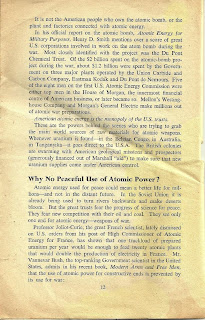


Notes on this pamphlet:
"Why they want War – They want war because, as Lenin once said, war is terrible, but it is also terribly profitable."
“It is because America does not belong to the American people. The wealth of America, its mineral resources, its great plants and factories, its banks, its press, its government, are in the hands of a tiny group of great capitalists, whose aim is profit and not the welfare of the people.”
This is true of the missiles on the Gare Loch here in Scotland – we don’t own or control them. Instead, the millionaires and corporations controlling our democracy through ownership of the press and their ability to use their financial power to lobby the mainstream parties own and control the weapons of war here.
Back in the dark days of Blair and Bush, millions trod the streets of the UK in opposition to war in Iraq – yet the profitable thing to do for the oil corporations and the weapons of war manufacturers was to sex up documents that in their original form had shown no call for war. Blair’s wars were fought for the capitalist elite. No working class person profited… in fact the majority by far of the hundreds of thousands of people who have died in Iraq and Afghanistan have been the very poor. The majority of the soldiers who have died on all sides are working class people, driven to fight other poor people in the interest of shareholders and millionaires who sit comfortably and increase bank accounts that were used to bring down the economy across the globalised world. How much good would the monies used to build these weapons do for the poor and working class?
“Armaments can always be pushed if private (business) activity slows. War scares are easy to create and are nearly sure-fire producers of money for more and more arms.2 (The business journal US News and World report 17.2.50)
After WW2 bankruptcies in small business in the US increased, whilst because of the “red scare” mongering, large corporations connected with war (who had a 90% share in the national press) increased their sales by 5% by 1948. In a call reminiscent of the present cuts agenda of the ideologically driven Tories and Liberal democrats, the Magazine of Wall Street said about social welfare in 1950 – “this is not the time to strain the economy by pushing ahead with all kinds of social experiments which would add billions to the budget.”
This pamphlet is a great read. A fantastic expose of the post WW2 capitalist ecomomy and a great tract against the use of nuclear power for war.
Click on the pages to expand.
More pamphlets from the past HERE


Sunday, 12 September 2010
SSP Campsie Radio!
SSP Campsie Radio!
This is the first foray into podcasting by SSP Campsie. Please leave comments/suggestions below; by email eastdunbartonshiressp@hotmail.co.uk; by Twitter - @sspcampsie or by text - 07541392522
Be kind!
Click on the link to go to our test podcast! This is also available on itunes...
This is the first foray into podcasting by SSP Campsie. Please leave comments/suggestions below; by email eastdunbartonshiressp@hotmail.co.uk; by Twitter - @sspcampsie or by text - 07541392522
Be kind!
Saturday, 11 September 2010
Comrades Bill and Willie's Birthday do...
Campsie Comrades got together after a spot of leafleting to celebrate Bill and Willies birthday.


Wednesday, 8 September 2010
International Socialist Review 1968
The International Socialist Review ran between 1956 and 1975. It was a Trotskyist publication produced by the Socialist Workers Party (United States – not to be confused with the SWP in the UK)from 1956 to 1975 in magazine format, and until the 1990s as a supplement to the organization's weekly newspaper, The Militant. This publication succeeded the organization's theoretical magazine, Fourth International.
May 1968 refers to the strikes and demonstrations that rocked France during that time. These events are said to have influenced demonstrations and actions against tyranny across Europe and indeed the world.
This edition was written by the famous french Trotskyist, Pierre Frank.
Click on the pages to expand.
More pamphlets from the past HERE


Subscribe to:
Posts (Atom)